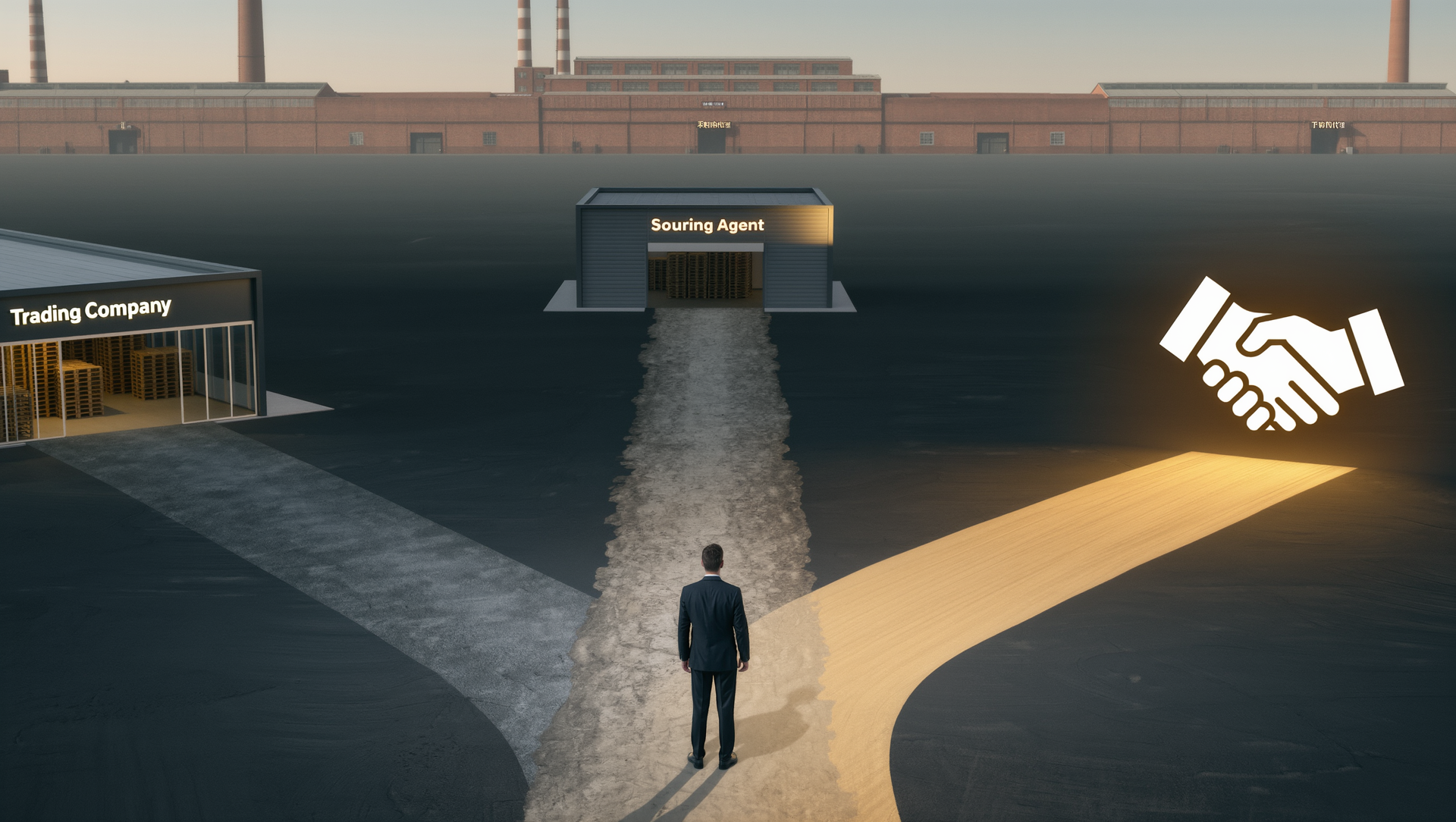
Sourcing Agent vs Trading Company vs Direct Factory — Full Comparison
When a European importer starts looking for goods in China, they quickly encounter three types of entities: a sourcing agent, a trading company, or a direct factory. Each has different implications for price, quality, flexibility and risk. And there is a fourth model — the one Oriental IMEX uses — combining the advantages of both agent and trading company without their drawbacks.
Option 1: Direct Factory. Theoretically the cheapest option — no intermediary markup. In practice it requires: knowledge of Chinese, experience in factory verification, ability to independently supervise production. Works only with long-term, verified relationships with a specific manufacturer. On a first order or new product — risk is very high. Additional issue: many Chinese factories have their own trading offices, so "directness" is often an illusion.
Option 2: Trading Company. A Chinese company buying from multiple factories and reselling to foreign clients. Advantages: single contact, good English support, efficient export documentation. Disadvantages: hidden markup (10–20% on factory price), acts in its own margin interest — not yours, limited recourse on quality claims. Common phrase: "we are both factory and agent" — in 80% of cases, it is a trading company.
Option 3: Traditional Sourcing Agent. Acts on behalf of the buyer. Transparent remuneration, factory verification, quality oversight. Weakness: the agent is an intermediary — you hold the contract with the factory directly; the agent has limited formal leverage over the factory.
The fourth model — Who is Oriental IMEX? We are neither a pure agent nor a trading company. We use a client-of-record model: we enter the transaction as the formal client to the factory on behalf of the European importer. In practice: the factory sees us as their long-standing, regular client — not a one-time European importer they know nothing about. This means: (1) the factory treats our quality requirements as binding, because they risk losing future orders from us; (2) we can withhold payment or demand rework when quality does not meet specification; (3) the European importer is protected by our contractual position, not just an intermediary's commission; (4) factories give us better prices and production priority because we are a reliable, repeat buyer. No hidden factory markup — we charge a transparent service fee. We act in the importer's interest — not the factory's.
When to choose which option? Direct factory: only with long-term verified relationships with a specific manufacturer. Trading company: for small mixed catalogue orders where speed matters more than price. Traditional agent: when you want to manage the factory relationship yourself and need support only in finding a supplier. Oriental IMEX: on first import or new product, for custom manufacturing (OEM/private label), when quality inspection and certifications are required, for orders above ~USD 5,000 where full service is cost-effective.
Alibaba vs. sourcing agent. Alibaba is a platform — it does not verify quality, does not protect on quality claims, does not supervise production. Trade Assurance protects against complete non-delivery but not against defective goods. Alibaba is a good starting point to identify factories — but it does not replace an agent with physical presence in China.
Frequently asked questions
What is the difference between a sourcing agent and a trading company in China?
A sourcing agent acts in the buyer's interest with transparent commission. A trading company buys from factories and resells with a hidden 10–20% markup. Oriental IMEX uses a fourth model — client-of-record: we enter as the formal factory client, without hidden markup, with full contractual protection.
Is it worth buying directly from a Chinese factory?
Only with long-term, verified relationships with a specific factory and with own production supervision capability. On a first order or with a new supplier the risk is very high — factories often have their own trading offices and "directness" can be an illusion.
Planning to import from China?
Describe your project and we will send a quote with no hidden costs. We reply within 24 business hours.
Request a Quote